

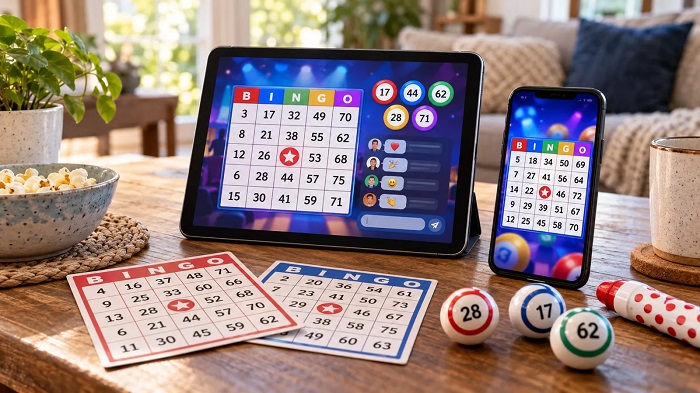
For decades, the mental picture of bingo remained virtually unchanged. You pictured a brightly lit community center or church basement, long rows of folding tables, the faint scent of coffee, and stacks of paper cards weighted down by good-luck trinkets. Players guarded their cards with intense, quiet focus, ready to stamp down a felt-tipped ink dauber the second a caller drew a numbered wooden ball. It was a cherished ritual, but it was strictly an event: scheduled, localized, and tied to a physical room.
That entire ritual now fits neatly into the palm of a hand. Smartphone screens have replaced paper grids, digital taps have replaced physical daubers, and the rigid two-hour community hall schedule has dissolved into rapid micro-sessions on the morning commute. Mobile technology has not simply digitized bingo; it has fundamentally reorganized how people interact with one of the world’s most enduring games of chance. By eliminating logistical friction and weaving modern gaming conventions into the core experience, mobile platforms have elevated a classic pastime into an on-demand cultural staple.
From Community Basements to Cloud Servers
The initial migration of bingo to the digital world took place on desktop web browsers in the late 1990s, but the smartphone era proved to be the genuine turning point. Physical bingo halls, while rich in atmosphere, carry inherent friction. They require reliable transportation, strict time commitments, and a high level of physical coordination to scan and mark multiple paper sheets in real time without missing a number.
Mobile technology erased those barriers almost overnight. Today, a player can open an app, enter an active lobby within seconds, and play alongside thousands of participants from around the world. Cloud servers handle the logistics continuously, ensuring that a fresh round is always preparing to start, whether it is lunch hour on a Tuesday or late night on a weekend. By removing the need to travel and synchronize schedules, mobile gaming shifted bingo from a planned destination to a spontaneous, casual reflex.
Modern Mechanics That Reinvented the Gameplay Loop
Traditionalists often wonder whether the core appeal of bingo survives once the tactile elements are gone. In practice, modern game studios did far more than build a digital facsimile of a paper card. They infused the game with sophisticated mechanics drawn from mainstream casual and mobile gaming.
Automated Daubing and Cognitive Freedom
In an analog setting, handling more than a handful of cards at once is an exercise in high stress. A single moment of divided attention can mean missing a number and forfeiting a win. Mobile gaming introduced automated daubing and intelligent visual cues, which mark called numbers automatically or brightly highlight eligible tiles.
Rather than removing the fun, this automation frees players from clerical anxiety. Users can comfortably manage ten, twenty, or even more cards simultaneously without cognitive overload. The result is a brisk, high-tempo experience where near-misses, strategic choices, and multiple simultaneous pattern completions occur far more often than in the physical version.
Gamification and Progression Systems
Modern mobile bingo rarely stops at drawing numbers. App developers have integrated rich progression loops that reward regular play. Players earn experience points, advance across themed maps, unlock decorative card designs, and collect rare in-game achievements.
The introduction of active power-ups has added tactical depth to a format traditionally driven entirely by luck. Depending on the app, players can trigger timed bonuses that reveal free numbers, award extra coins, or double their rewards for completing a pattern quickly. These mechanics transform what used to be a passive waiting game into an active, engaging loop with tangible short-term goals and ongoing milestones.
Shattering the Demographic Stereotype
The most significant shift driven by mobile apps is who actually sits at the virtual table. Pop culture spent generations framing bingo as an exclusive pastime for older retirees. While seniors remain an enthusiastic part of the modern audience, mobile accessibility has cracked open the demographic door to a much younger crowd.
Millions of younger adults, particularly Gen Z and Millennials, now incorporate casual bingo into their digital routines. Having grown up with smartphones and casual puzzle games, these players appreciate the straightforward rules, vibrant animations, and instant gratification. Furthermore, the audience is increasingly diverse across gender lines, thanks to titles that emphasize high-speed multiplayer tournaments, fantasy storylines, and collectible mechanics. The game has shed its dusty reputation and established itself as an energetic, accessible casual title suitable for anyone with a few minutes to spare.
The Digital Social Hall
When bingo first transitioned to screens, skeptics predicted that the loss of physical presence would strip the game of its greatest strength: community. After all, traditional halls were community anchors where people gathered to trade stories, celebrate local news, and catch up with neighbors.
Developers answered this concern by making the social experience a core feature of the software. Built-in chat rooms, interactive stickers, and virtual gifting systems allow players to cheer each other on in real time. Many platforms employ live chat hosts who run trivia contests, mini-games, and seasonal celebrations right alongside the main number calls.
Rather than isolating players, mobile platforms have created international networks of regulars. It is common to see players who live thousands of miles apart log on at the same time every day to play rounds together, compare progress, and catch up on everyday life. The community never disappeared; it simply found a broader, borderless canvas.
Micro-Sessions and the Pace of Everyday Life
The cadence of personal entertainment has changed dramatically. Extended, uninterrupted blocks of leisure time have become a luxury for many. Modern audiences frequently rely on micro-sessions—short, self-contained bursts of entertainment that fit cleanly into the natural pauses of the day.
Mobile bingo matches this modern rhythm perfectly. A standard game lasts between two and four minutes, making it an effortless accompaniment to waiting in line, sitting in a waiting room, or relaxing on the couch after dinner. Players control the pace entirely. They can participate in a single rapid round and close the app without penalty, or settle in for an extended run of games when time allows. This flexibility makes bingo an appealing, low-pressure alternative to complex, demanding video games.
The Future of the Pocket-Sized Card
The evolution of mobile bingo continues to accelerate alongside mobile hardware. Live-streamed bingo, featuring human hosts broadcasting studio entertainment directly to mobile devices, has merged the energy of a live game show with mobile interactivity. Experiments with augmented reality, customized player rooms, and social team tournaments continue to push the medium forward.
Yet, despite all the technological polish, the fundamental appeal remains timeless. The suspense that builds as you wait for that one final number to complete a diagonal or full house carries the exact same emotional excitement whether you are marking cardboard in a packed local hall or holding a smartphone on a bus. Mobile gaming did not replace bingo; it set it free, ensuring that one of the world’s favorite games remains lively, social, and accessible for the modern era.

Comments are closed.